Music Fandom vs. Narrative Fandom

Over the years, I’ve found myself mulling the differences between fandoms organized around narrative and those organized around music. It’s now a topic on which I have to pull together my thoughts in 1000 words or less for Henry Jenkins et al’s book on spreadable media. This post is really just me thinking outloud in a rough stab at a start. I would LOVE your feedback on the distinctions I’m drawing and those I’ve missed.

Narratives have characters, plots, and holes to be filled by fan creativity. Music doesn’t. Sure, you can get into discussions of lyrics, and there are many fan lyric interpretation sites out there, and heaven knows you can obsess on the musicians, but for all the time I’ve spent in music fandom, lyric interpretation has never seemed all that important to the social life around music. Music fans interpret what’s best and what’s worst in an artists’ catalogue, and they review shows, but it’s just a whole lot harder to talk about the significance of that chord change or the way that bridge takes the song into the third verse than it is to talk about what that shot of the window at the end of the scene was meant to imply or what a character meant when she said what she said.

Narrative also leaves space for much more fan creativity. Music fans may make their own videos to accompany songs, or form cover bands, or write fan fiction about musicians, but with the important exception of remixes, which remain a fairly marginal fan practice, I’ve never seen fans write songs in the same way that fans of a TV show will write stories using the characters. Music fans don’t seek to complete the music through interpretation and creativity. The music arrives complete. Fans can’t fix it or rebuild it in the same way they can with stories.

Music fans are far more likely to focus on news and information. Narrative fans certainly do this, building timelines and keeping abreast of production, casting, and so on, but music fans seem to do this as their primary activity. It’s all about when the album will be released, what the setlist will be, when the tour will happen, and what songs were played what night in what order. This is why music fan communities on the internet tend to get very quiet when the most recent album has been out for a while and the band isn’t touring. What’s to discuss?

Music fans also share the very objects of their fandom by making mix tapes, playlists, writing mp3 blogs, and sending one another recordings and bootlegs. On occassion, narrative fans will share a recording of a missed show with another fan, but, like lyrical interpretation in music fandom, this seems like a marginal practice in narrative fandom.

But I’m thinking that perhaps the most important distinction between the two fandoms is the way that music fans take the resources of their fandom outside of that fandom as part of their self-presentation in other contexts. Think t-shirts with band names (Rob Walker’s excellent book Buying In reports that Ramones t-shirts have outsold Ramones albums 10 to 1). Think playlists embedded on social network profiles. Think bumper stickers (I think “Republicans for Voldemort” is the only narrative fandom bumper sticker I’ve ever seen, though I’ve seen hundreds of stickers naming bands). When I used to work in a record store and grandmothers would come in at Christmas time to buy a gift for the grandkid and ask “what are all the kids listening to these days?” we’d respond “what kind of haircut does your grandchild have?” How does a Lost fan dress? Can you spot a Star Wars fan walking down the street? Narrative fandom is invisible unless it’s being discussed. Music fandom is much more likely to be made visible as an intrinsic part of self-definition in a wide variety of situations.

The upshot is that we should be wary of taking the practices of narrative fandom on which most fandom theory has been built as exemplary of all fandom. Different kinds of materials call for different kinds of practices, and if we’re to build theories that encompass all of fandom, we need to account for these distinctions as well as the similarities.

  • Share/Save/Bookmark

Best Twitter Exchange Ever: Burgess vs. Keen

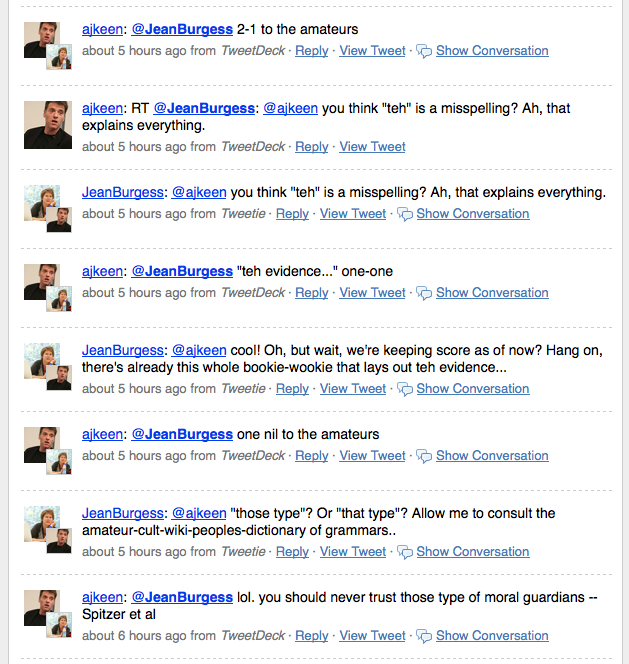
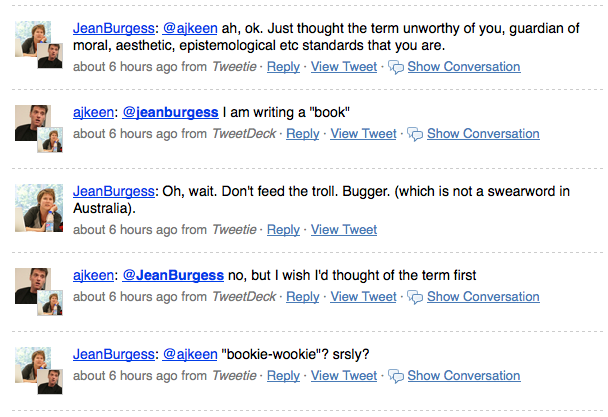
Normally I wouldn’t rebroadcast others’ (public) Twitters on here, but I cannot resist sharing this wonderful bit of banter between Andrew Keen, Mr. Cult of the Amateur, famous for his argument that all those non-professionals on the internet are destroying culture what with their lack of professional editing and all, and Jean Burgess of Queensland University of Technology, an expert in digital “vernacular” and co-author with Joshua Green of a forthcoming book on YouTube I’ve been lucky enough to read already.

It started with Keen tweeting about working on his “bookie-wookie.” Jean retorts (It’s a Twitter exchange, so scroll down now and read bottom to top, not top to bottom):

picture-2picture-1

Give him credit for maintaining a sense of humor, but with “You think “teh” is a misspelling? Ah, that explains everything,” it’s definitely Burgess FTW!

And while on the subject of  tweets that beautifully demonstrate the linguistic creativity and playfulness of Twitterspeak, I point you to Music Ally’s summation of the ten best tweets sent by Peter Sunde while on trial recently in Sweden for his role as co-founder of Sweden-based-world’s-largest bit torrent tracker, The Pirate Bay.

UPDATE: I fixed the broken link to the MusicAlly blog — thanks to those who alerted me to my mistake.

  • Share/Save/Bookmark

We Are Ready to Barack and Roll

One thing I love about my new President is that he inspires his followers to create in ways that erase the boundaries between politics and fandom. Here’s to President Obama:

I’ve got this image on today:

my shirt

Now let’s fix the world.

  • Share/Save/Bookmark

Fan Labor: Exploitation or Empowerment?

Hi there. Remember me? Ok, so I’ve been an epic blogging fail lately. But there’s a good reason! I’ve been writing full length things. Like the 2 papers I’m about to share here.

This coming week I’ll be in Copenhagen presenting at the Association of Internet Researchers’ ninth annual conference (Internet Research 9.0). I’m giving two papers, one about Swedish indie fans online and one about friending on Last.fm.

Here is the paper about Swedish indie fans. My collaborator Robert Burnett and I interviewed a number of mp3 bloggers, archivists, indie label guys and musicians. In this, we demonstrate the importance of the (unpaid) work fans do in spreading this music beyond the border of Sweden, making it a globally accessible and appreciated commodity, and we pose the question of whether this is exploitation or empowerment.

There is a critique of Web 2.0 that argues it is based on free labor done by users from which others profit. We argue that this critique has some merit, but undervalues the rewards fans get from doing this kind of work. We identify the costs fan laborers pay and the rewards they receive. In the end, the tension between empowerment and exploitation is one that each fan laborer has to manage on his or her own. We identify three strategies through which they do this: distancing themselves from the scene as outsiders, viewing themselves as peers of those they ‘work’ for, and viewing their work as an investment in a future career.

You can download the paper here.

Come back next week for the Last.fm paper.

  • Share/Save/Bookmark

What to do when fans post live videos

Prince may be eagerly suing everyone who posts live videos of his shows on YouTube, but the Swedish label Songs I Wish I Had Written, headed by Martin Thörnkvist, one of the leaders of music-business think tank The Swedish Model, is taking the opposite strategy. They’re eagerly promoting Moto Boy these days, an interesting artist who sounds kind of like a delicate and emotive 50s crooner but looks kind of like a Bowie drag queen glam heavy metal wannabe. He’s all about contrast.

He plays out a lot, just him and his flying V guitar, and he’s got a devoted live following who are posting videos from all his shows on YouTube. Thörnkvist went through them all, picked the best version of each song, and put it together into a Moto Boy YouTube concert. He couldn’t post it to YouTube since it’s too long, but he posted it at Vimeo in a version that fans can not only watch, but embed wherever they want:


Moto boy – Youtube concert from Pickybe on Vimeo.

This is the perfect way to respond to YouTube fan videos. Find the best and highlight them. It can only do your artists good.

  • Share/Save/Bookmark